
The Wedding Societe lookbook 2026 brings together voluminous silhouettes, textured fabrics, artistic lace, floral details and subtle sparkle. These are the defining directions to watch, balancing statement-making shape with considered detail. For brides weighing up which elements feel right for their wedding, the lookbook offers a clear starting point for exploring the season’s aesthetic.
A dramatic skirt can create presence, while lace, dimensional florals or a hint of shimmer can add character without overwhelming the overall look. The best details are the ones that feel aligned with your style and setting, whether you’re planning a formal Sydney celebration or a relaxed coastal wedding. This guide breaks down how each trend shapes the gowns, what makes the details distinctive and how to use them as inspiration when refining your bridal vision.
Key Takeaways
- Compare structured, full skirts with cleaner silhouettes to find the level of volume that suits your wedding style.
- Look at how fabric texture, pearls and dimensional florals add interest, then decide which detail should take focus.
- Use lace placement and floral accents to shape the gown’s overall effect, from delicate to more dramatic.
- Consider subtle beading for a gentle touch of light without letting embellishment dominate the look.
- Explore the labels featured in the lookbook, then use their design details to guide your search for a gown in Sydney.
Dramatic silhouettes and voluminous skirts
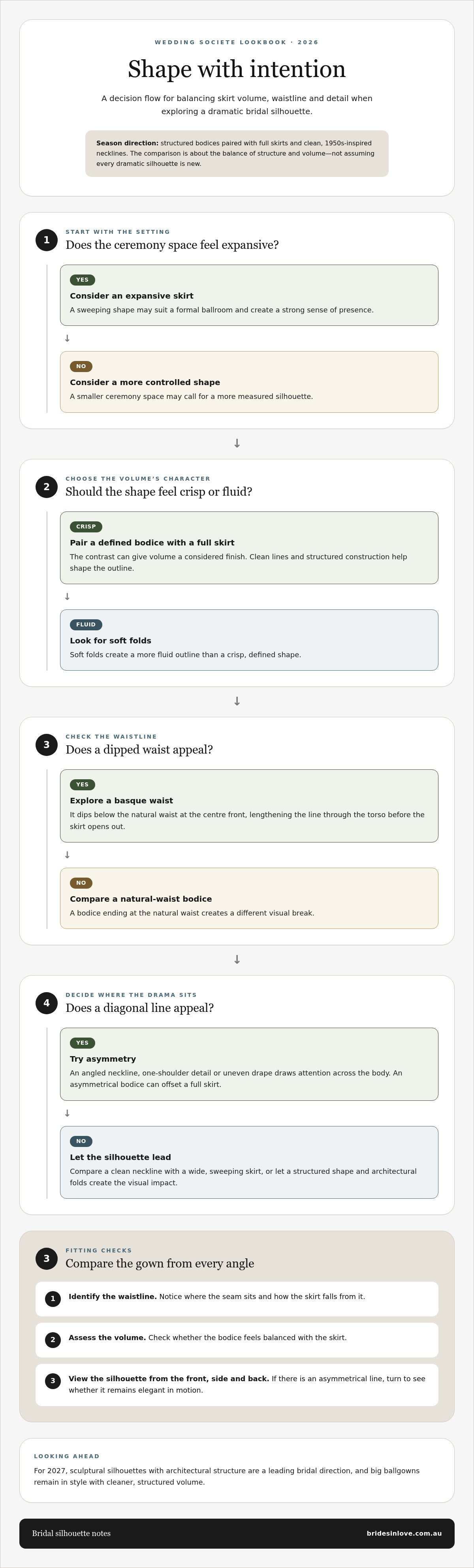
A useful comparison between the 2025 and 2026 collections is the balance of structure and volume. For 2026, bridal fashion is forecast to pair structured bodices with full skirts and clean necklines inspired by the 1950s. Treat this as the season’s direction, rather than assuming every dramatic silhouette is new.
Volume depends on proportion, not skirt width alone. A defined bodice can give a full skirt a crisp, considered finish, while soft folds create a more fluid outline. A clean neckline above a wide, sweeping skirt, for example, makes the contrast feel deliberate rather than simply oversized. For Sydney brides, the venue can help guide the choice: an expansive skirt may suit a formal ballroom, while a smaller ceremony space may call for a more controlled shape.
The waistline changes the effect, too. A basque waist dips below the natural waist at the centre front, lengthening the line through the torso before the skirt opens out. A bodice that ends at the natural waist creates a different visual break. When trying either shape, check the front, side and back views. Notice where the waist seam sits, how the skirt falls from it and whether the bodice feels balanced with the volume.
Sculptural and architectural silhouettes make the gown’s construction part of its visual impact. Strong seams, crisp folds and defined skirt shapes can create a composed outline from different angles. This direction carries into 2027, when sculptural silhouettes with architectural structure are a leading bridal trend. Big ballgowns also remain in style for 2027 weddings, with cleaner, structured volume updating the classic shape. These trends point to shape with intention, rather than fullness for its own sake.
Asymmetry offers a different kind of drama. An angled neckline, one-shoulder detail or uneven drape draws attention across the body rather than creating a mirrored frame. An asymmetrical bodice can offset a full skirt with a defined diagonal, while a simple skirt lets the neckline lead. In a fitting, turn from the front to the side and back to see whether the line remains elegant in motion.
Use three checks when comparing dramatic pieces: identify the waistline, assess the skirt’s volume, then view the silhouette from several angles. A 1950s-inspired neckline, basque waist or architectural fold can each shape the final impression. The Wedding Societe lookbook 2026’s clearest trend reference is structured volume, giving brides a practical starting point for choosing between a classic ballgown and a more sculptural outline.
The 2026 direction pairs structured bodices with full skirts and clean, 1950s-inspired necklines. Dramatic silhouettes are not necessarily new, so the comparison is about the balance of structure and volume rather than a wholly new shape.
Textured fabrics, pearls and 3D florals
Fabric changes how a bridal dress looks in photographs, moves while walking and feels against the skin. The 2026 fabric direction spans delicate and corded lace, sheer and shimmering materials, detailed embroidery and satin. Each creates a different effect: sheer layers soften a silhouette, while satin gives it a smoother, more defined surface. Treat texture as part of the design, not just a finishing detail. A simple dress can feel distinctive through fabric alone, while an embellished gown benefits from a more considered balance.
Compare how each material responds to light. Shimmering fabric catches highlights across a larger area, while embroidery draws attention to specific places. Detailed stitching on a bodice can draw the eye upwards, for example, while a satin skirt keeps the lower half visually composed. Sheer overlays add depth without concealing the layers beneath. Look at the fabric in daylight and indoor lighting, since the same surface can appear different at a Sydney ceremony and reception.
Pearls add texture, but placement matters more than quantity. A row along the neckline gives a delicate finish; scattered pearls across a sleeve create a more noticeable pattern. On a plain bodice, pearl accents can become the main detail. Against lace, they may compete with existing motifs unless their scale and placement are balanced. Compare a close-up with the full-length view to see whether the embellishment complements the dress or distracts from its shape.
Three-dimensional florals bring raised detail beyond the flat surface of printed or embroidered motifs. For 2027, tactile textures including 3D florals, pleating and feather trim are leading wedding dress trends. This points to a continued interest in fabric that can be seen and felt, rather than surface decoration alone. A cluster of fabric flowers at one shoulder creates a focal point; floral appliqués spread across a skirt make the texture more prominent. These are styling examples, not a claim that every lookbook dress uses them.
Draping adds movement through folds and gathers, while pleating creates more defined lines. A softly draped panel can complement delicate lace, whereas sharp pleats make a stronger statement beside satin. Use this three-step check to compare details while trying on gowns:
- Notice whether the fabric catches light, absorbs it or appears sheer.
- Check where pearls, embroidery or 3D flowers draw attention.
- Move and sit to see how draping and raised details behave.
For a balanced bridal look, choose one leading texture and keep supporting details quieter. A satin base with a few pearl accents creates a different effect from embroidered lace paired with dimensional florals. These combinations help translate bridal fashion trends into a look that feels considered, personal and suited to the occasion.
Artistic lace and bold floral details
In 2026, lace remains one of the key ways bridal gowns can gain depth without changing their overall silhouette. The season’s fabric direction includes delicate lace and corded lace, alongside sheer materials, detailed embroidery and satin. Delicate lace gives wedding dresses a softer finish, while corded lace adds a more defined pattern. Compare both at close range and from a distance: fine motifs may read as subtle texture, while raised or heavier lines can become a focal point.
Placement shapes the effect as much as the lace itself. A lace neckline frames the face, while sleeves carry pattern along the arms. Lace concentrated at the bodice draws attention upwards; motifs continuing onto the skirt create a more connected look. For a minimal approach, pair one defined lace area with quieter fabric elsewhere. For a bolder result, let repeated motifs extend across several parts of the gown. Check the front and back views, since a detail that feels balanced from one angle may dominate from another.
Floral design can shift from delicate to expressive through scale, colour and placement. A small embroidered flower near the waist creates a restrained accent; larger floral appliqués across a skirt make the pattern central to the design. The Wedding Societe lookbook 2026 trend forecast also draws inspiration from Victorian and Baroque structure and embellishment. Those references suggest ornate motifs and decorative placement, balanced by clean lines where the gown needs visual space. The aim is contrast, not adding detail everywhere.
Colour offers another way to make a floral motif stand out. Spring-Summer bridal collections frequently include silk organza gowns with hand-painted light blue flowers and blush dresses embroidered with green ivy. These examples show how a coloured botanical design can complement the gown’s base rather than rely on white-on-white detail. The wider direction also includes non-white shades such as champagne, blush, black and deep jewel tones. A floral motif can therefore feel subtle against a similar tone or graphic against a contrasting ground.
Use this fitting-room sequence to assess lace and floral details:
- Identify the first feature your eye notices, such as a lace sleeve or embroidered bodice.
- Check whether the pattern continues naturally across seams and changes in fabric.
- View the gown in daylight and indoor lighting to compare colour and texture.
- Consider the ceremony setting: a garden backdrop may echo botanical motifs, while a clean-lined venue can make ornate lace stand out.
For Sydney brides choosing between artistic and minimal wedding dresses at Brides in Love, let one feature lead. Pair a floral skirt with a restrained bodice, or let intricate lace stand alone without extra motifs. This balance keeps the look composed and gives the craftsmanship room to stand out, while a clean-lined venue can offer a quieter contrast. Mantilla veils are circular, Spanish-style lace head coverings historically worn during religious ceremonies to cover the hair and shoulders. Their lace can echo a gown’s motif, while the circular shape frames the face and shoulders distinctively.
Subtle sparkle and embellishments
Beading can add dimension without making a bridal gown feel heavily decorated. According to Bloom Australia, intentional beading gives a gown depth without an overwhelming effect. Placement is key: a fine scatter across the bodice reads differently from dense embellishment along the neckline. For understated glamour, compare how each treatment sits against the gown’s fabric and silhouette.
Small reflective details can also affect how a dress appears in photographs. Bloom Australia notes that subtle sparkle can create a delicate, luminous look in wedding photography. A few beads near the waist may catch the light as the bride moves, while embellishment across a full skirt can create a broader glimmer. Consider the ceremony lighting, too: bright outdoor light and a dim reception room show reflective surfaces differently.
Let the gown’s structure guide the placement of sparkle. On a corsetry-inspired bodice, beading along the seams can draw attention to the construction. A basque waist already creates a defined line below the natural waist, so a small cluster near its point may emphasise the shape. By contrast, embellishment scattered across the bodice and skirt can compete with a strong waistline. Compare each option from the front and side to judge the balance.
No single placement suits every design. A simple neckline can carry a delicate beaded edge, while a detailed bodice may look more composed with a quieter skirt. If the gown features lace or floral texture, choose embellishment that complements rather than covers the pattern. Clear beads can add light without introducing another strong colour; tonal beads blend into the fabric for a softer finish.
During a fitting, assess sparkle close up, at full length and in motion. A close-up reveals bead size and spacing. The full-length view shows whether embellishment draws attention away from the overall shape. Walking or turning shows how the details catch changing light. These checks help you distinguish restrained shimmer from a more prominent statement.
Brides comparing embellished silhouettes can use this quick guide:
- Choose a focal area, such as the neckline, corsetry seams or basque waist.
- Keep surrounding surfaces quieter if the focal detail is dense.
- View the gown under both natural and indoor lighting.
- Move in the dress to see whether the sparkle stays subtle in motion.
For a refined finish, let one feature lead. Beading along a neckline, a softly illuminated bodice or a light touch at the waist can each give a gown character. The Wedding Societe lookbook 2026’s sparkle direction is best read as considered detail: enough shimmer to add depth, with the silhouette still taking centre stage.
Which Australian designers and labels appear in the Wedding Societe 2026 lookbook?
Wedding Societe is the label this guide can identify in connection with the 2026 lookbook. No individual Australian designer should be credited without a clear attribution in the lookbook itself. This distinction matters: a label name identifies the collection, while a designer credit identifies the person or studio behind its design. For Sydney brides comparing gowns, keeping those details separate avoids confusing a brand with a designer.
Use the exact label name when saving looks or discussing them with someone helping you plan. For example, note “Wedding Societe” beside a gown image, then record any designer credit printed with it. If no designer is credited, keep your note to the label. This simple step keeps your shortlist accurate and easy to revisit as you compare bridal styles.
Australian bridal fashion includes labels with distinct design identities, but a trend feature alone doesn’t establish who designed a gown. A full skirt, artistic lace or floral detail describes a look, not its creator. A photograph’s styling and setting don’t prove where a gown was designed, either. Check the label or designer credit attached to the specific look before attributing its details to an Australian studio.
When reviewing a lookbook, separate the label, any named designer and the visual features. For example, “Wedding Societe” is a label reference, while “lace bodice” describes a design feature. Keeping these notes in separate columns helps you compare gowns without turning a trend into a brand claim. It’s also useful when sharing saved looks with family or discussing silhouettes during a Sydney fitting.
For a practical shortlist, use these steps:
- Write down Wedding Societe as the label associated with the look.
- Copy a designer’s name only when the lookbook gives that attribution.
- Record the gown’s visible details separately, such as lace, floral motifs or skirt shape.
- Compare those details with the style you want, rather than assuming every trend belongs to one designer.
This approach keeps the answer precise: Wedding Societe is the named label relevant here, while a separate Australian designer credit requires direct attribution. Brides interested in trying gowns from this label can book a bridal appointment and discuss the silhouettes and details that appeal to them.
Bloom Australia notes that a higher-neckline gown can work for the ceremony, with a softer, slinkier outfit change for the party. This offers a way to think beyond a single gown: consider whether one silhouette suits the ceremony and whether a change in texture or ease better matches the celebration afterwards. Treat this as a styling idea, not a designer attribution; it doesn’t identify who created a particular look.
When saving a Wedding Societe image, note whether its neckline feels suited to the ceremony and what kind of second outfit you might prefer for the party. Keep observations about the gown’s appearance separate from the label and any designer credit shown. If you discuss the idea during a bridal appointment, describe the contrast you want between the ceremony look and party outfit. This makes your preference clear without treating a styling suggestion as proof of who designed the gown or where it was made.
Brides in Love: Zavana Bridal Gowns
Brides in Love offers Zavana Bridal Gowns for brides exploring a different design direction after reviewing the Wedding Societe looks. Comparing gowns across labels can help clarify which details matter most, from silhouette and fabric to lace or embellishment. Brides in Love also offers Wedding Societe Gowns, alongside White April Gowns and Cizzy Bridal Gowns, giving Sydney brides several labels to consider as they refine their shortlist. Turn to these options when you’re ready to move from trend inspiration to exploring gowns in person. Bring saved looks or notes on the features you liked, such as structured volume or delicate detailing, to focus your selection. Contact Brides in Love to explore the gowns that suit your bridal style.
Turn bridal inspiration into your shortlist
Use the Wedding Societe lookbook 2026 as a starting point, then decide which design details feel most like you. Consider how your preferred gown will work with the ceremony setting, the way you want to move, and the overall mood of your wedding. A saved image can guide your choices, but seeing different designs together can help you refine your direction.
Brides in Love also offers Zavana Bridal Gowns and White April Gowns. Exploring these labels lets you compare distinct bridal aesthetics while keeping your preferences at the centre. Bring a shortlist of details you love, such as a particular neckline or finish, to focus your appointment.
Book an appointment with Brides in Love and take the next step towards finding a gown that feels distinctly yours.
Frequently Asked Questions
What wedding dresses and bridal styles are featured in the 2026 lookbook?
The Wedding Societe lookbook 2026 highlights bridal looks shaped by full skirts, structured bodices, textured fabrics, artistic lace, floral details and subtle sparkle. For a Sydney wedding, use these elements as a styling guide: a clean, voluminous silhouette can suit a formal reception, while delicate lace or restrained embellishment may better match a relaxed celebration. Choose one or two details to guide your gown shortlist, rather than treating every trend as essential.


