
What if your dress appointment could adapt to you, rather than asking you to adapt to a sample gown? If you’re worried about sizing, mirrors, photos or comparisons, you don’t have to feel excited every moment. Overcoming body image issues when dress shopping can start with recognising that a sample’s fit reflects the garment in front of you, not your worth or how you should look.
It’s understandable to feel pressure to enjoy an experience that may also bring up difficult emotions. You deserve to shop at your own pace, set boundaries around what feels comfortable and focus on how a gown makes you feel, not the number on its label.
This guide shares practical ways to prepare for appointments, manage mirrors and comments, and ask for the support you need. At Brides in Love’s spacious Wetherill Park showroom, personalised one-on-one consultations and experienced bridal stylists help keep the search focused on your preferences.
Key Takeaways
- Make a simple appointment plan: decide what support you need, choose companions who respect it and allow time for a pause.
- Wear comfortable clothes and familiar underwear that make changing easier.
- Use clips and pins as styling aids, not as a verdict on how a finished gown will fit.
- Prepare neutral replies to comments or comparisons, and give yourself permission to take your time.
- A one-on-one consultation at Brides in Love’s Wetherill Park showroom offers focused styling support from bridal experts with more than a decade of experience.
Why wedding dress shopping can stir up body image worries
You can be excited to look for a wedding gown and still feel uneasy about the appointment. Those feelings aren’t contradictory. A bridal fitting brings attention to your appearance at a time when you may already be thinking about how you want to look on your wedding day. Feeling self-conscious doesn’t mean you’re ungrateful or doing the experience incorrectly.
Several things can sharpen that self-consciousness at once. Bright or unfamiliar mirrors, photos, a sample that sits differently from your usual clothes, and the close assistance needed to get dressed can make you feel unusually observed. Add opinions from loved ones and expectations about what a bride “should” look like, and it’s easy for the appointment to feel like a test rather than a chance to explore what you like.
Body image is shaped by how you think and feel about your appearance, and it can shift with your surroundings and experiences. A gown sample is a try-on garment, not a judgement of your body. A sample’s fit is a detail about the dress in that moment, never a measure of a bride’s worth.
Why a bridal fitting can feel more exposing than everyday shopping
A fitting room can feel like a spotlight: you change clothes, look at yourself from different angles and may need help with fastenings or adjustments. Each new gown can bring another round of mirrors and opinions. Even if your companions mean well, comments about fit or appearance may land differently when you’re already feeling exposed.
Wedding imagery and family expectations can add pressure to feel beautiful, confident and delighted every second. Supportive company may help you feel more at ease, but it can’t guarantee that difficult thoughts will disappear. You’re allowed to have a mixed experience.
Body image concerns and body dysmorphic disorder are not interchangeable
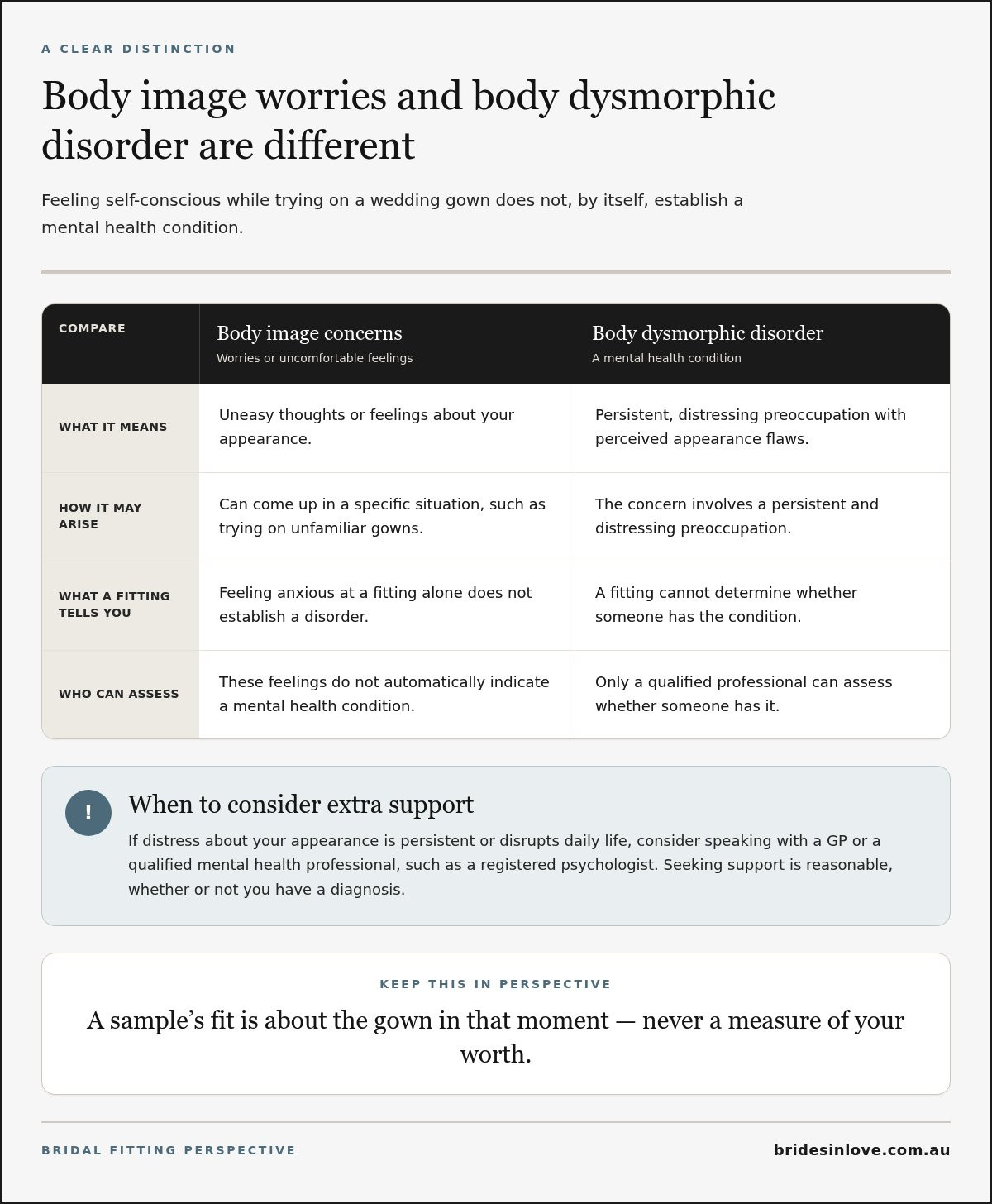
Body image concerns are worries or uncomfortable feelings about your appearance. They can arise in specific situations, such as trying on unfamiliar gowns, and don’t automatically indicate a mental health condition. Body dysmorphic disorder is a mental health condition involving persistent, distressing preoccupation with perceived appearance flaws. Only a qualified professional can assess whether someone has it.
This article can’t diagnose you, and feeling anxious at a fitting alone doesn’t establish a disorder. If distress about your appearance is persistent or disrupts daily life, consider speaking with a GP or qualified mental health professional, such as a registered psychologist. Seeking support is a reasonable step, whether or not you have a diagnosis. Overcoming body image issues when dress shopping doesn’t require forcing yourself to feel positive; it starts with noticing what you need.
How to prepare for dress shopping when you feel self-conscious
A little planning can make the appointment feel more manageable without asking you to control every feeling in advance. Think about what would help you feel respected, what you want from your companions and how you’ll give yourself room to pause. These choices put your needs at the centre of the experience.
- Identify what you need. Decide what would make trying on gowns more comfortable, such as hearing what to expect before a stylist assists you or having time to view a gown privately.
- Choose your companions with care. Invite people you trust to listen and respect your preferences, rather than choosing guests out of obligation.
- Set expectations. Tell your group whether you want their reactions, quiet support or opinions only when you ask. You can also agree that comments about your body and comparisons are off limits.
- Plan a pause. Pick a simple signal with a trusted companion that means you’d like a break, a glass of water or a moment away from the mirrors.
Decide what a successful appointment means to you. It doesn’t have to end with a gown chosen. You might simply learn which fabrics or necklines you enjoy, or become more familiar with the process. If you’re coordinating dress shopping with other wedding plans, Brides in Love recommends booking ideally 9 to 12 months before your wedding date. The Office on Women’s Health offers further reading on healthy body image and mental well-being.
Set your appointment boundaries before you arrive
A quick conversation beforehand can prevent you from having to manage everyone’s reactions while you’re changing. Try: “Please ask before offering an opinion,” “I’d rather not discuss my body,” or “Let’s focus on what I like about the gown, not how I compare with anyone else.” Adjust the wording to sound like you. Agreeing on a break signal also gives you a practical way to pause without explaining yourself in the moment.
Choose practical comforts without treating your body as a project
Wear clothes that are easy to change out of and bring familiar, comfortable undergarments that work with different necklines. You don’t need to buy special shapewear or prepare your body for the appointment. Your body isn’t a project with a deadline; you can shop as you are. If a focused, one-on-one setting would suit you, you can plan a bridal appointment around the support you’d like.
Preparation can’t promise that every moment will feel easy, but it can give you choices and language to draw on. Selecting supportive, well-crafted base layers from labels like ELSE beforehand can help you feel grounded and comfortable in your own skin. Ultimately, a practical part of overcoming body image issues when dress shopping is shaping the appointment around your comfort, rather than feeling you have to meet someone else’s expectations.
What a sample gown’s fit can, and cannot, tell you
A bridal sample is a garment for trying on, not a promise of how a finished gown will sit on your body. It may not match your measurements, and its proportions can feel different from a garment made or altered for you. That difference is information about the sample and fitting, not proof that a particular silhouette is wrong for you.
A sample shows how a design looks in that fitting; it cannot predict the exact fit of a finished gown. A sample that feels tight, loose or awkward in one area doesn’t rule out the style or gown category. The fabric, construction, sample size and how the garment is sitting can all affect what you see. Treat the fitting as a chance to explore design details, not as a verdict on your body or your options.
How clips, pins, and mirrors can affect what you see
A stylist may use clips or pins to hold excess fabric or bring parts of the gown closer to the body. This can suggest the intended silhouette and help you picture details such as the neckline, waist or skirt shape. Temporary pinning changes how the sample sits, though, and can’t perfectly recreate a gown made and fitted for you. Look at the overall design, not just one area in isolation.
Mirrors can also encourage close scrutiny, especially after you’ve been looking at polished wedding images online. If those images are shaping your expectations, the American Psychological Association has discussed the impact of social media on body image. A fitting-room reflection is one view of one sample at one moment. You can focus instead on how the fabric moves, which details appeal to you and whether the design feels like your style.
Responding when a gown or fitting-room moment feels wrong
You can pause, change gowns or finish for the day. If something feels uncomfortable, describe the experience rather than criticising your body: “This is pulling across the bodice,” “I’m not comfortable with how this is being pinned,” or “Could we take a moment before trying another?” Clear, specific feedback helps the stylist understand what you’re noticing.
You can also ask for a different fitting approach, such as a moment to view the gown without commentary or help interpreting how the sample is sitting. You don’t have to decide whether you like a whole style while feeling overwhelmed. Step back, name the design detail you want to assess, and return to it only if you’re ready. This is a practical part of overcoming body image issues when dress shopping: separating what the sample is doing from what you believe about yourself.
How to handle comments, comparison, and difficult feelings
A dress appointment doesn’t have to feel joyful from beginning to end. You might enjoy a gown’s design and still feel unsettled by a mirror, a comparison or someone else’s reaction. There’s no single correct way to experience this milestone, and a difficult moment doesn’t mean the appointment has failed.
Comments can catch you off guard, even when they’re meant kindly. A relative might compare gowns, mention your body or urge you to decide before you’re ready. You can redirect the conversation without defending your feelings or explaining your reasons.
Words to use when you need the conversation to change
Keep a few short phrases ready so you don’t have to find the perfect words under pressure. You might say, “Let’s talk about the gown, not my body,” or “I’d like feedback on the design, please.” A simple “No photos for now” is enough, too. You can decline pictures or end a conversation whenever you choose.
- “Can we focus on how the gown feels when I move?”
- “I’m not comparing my body or this dress with anyone else’s.”
- “I’m not ready to choose today. I’d like time to think.”
- “I’d prefer to pause this conversation.”
If the group is weighing in all at once, ask for one response at a time, or invite them to comment on specific details such as the neckline, fabric or how the skirt moves. This brings attention back to the gown and your preferences, rather than turning the appointment into a vote.
When shopping brings up more than expected
If a wave of discomfort arrives, try naming it privately: “I’m feeling exposed,” or “That comparison upset me.” You don’t have to argue with the feeling or decide whether it’s justified. If it suits you, step away from the mirror, take a break or contact someone you trust. These options may help, but no single approach works for everyone.
You can stop trying on gowns or leave for the day. That isn’t giving up. It’s a decision about what you need in that moment, and you can return to shopping another time if you want to. If distress persists, feels overwhelming or affects daily life, consider speaking with a qualified mental health professional.
Pressure to choose quickly can make it harder to hear your own preferences. A calm response such as “I need more time before making a decision” sets a clear limit without inviting debate. Overcoming body image issues when dress shopping doesn’t mean you’ll never feel uncomfortable; it can mean giving yourself permission to respond with care and take the next step at your own pace.
For details about a focused, one-on-one setting, read about bridal appointments at Brides in Love.
Find a supportive bridal appointment in Sydney
A considered appointment can give you space to explore what you like, ask questions and take the process at your own pace. At Brides in Love in Wetherill Park, personalised one-on-one consultations give Sydney brides focused styling guidance in a spacious showroom. Tell your stylist what would make the experience more comfortable, whether that means explaining each step before assisting or keeping feedback centred on the gown’s design.
You might also share what you hope to explore, such as a neckline, fabric or overall silhouette. Clear preferences can guide the conversation, while leaving you room to change your mind as you try on gowns.
What personalised styling can contribute to the experience
A focused consultation gives you room to discuss your priorities and questions as you consider different gowns. The stylist’s role is to offer guidance on design details, not to judge your appearance or pressure you into a decision. If a gown doesn’t feel right, that’s useful information about your preferences. Explain what appeals to you, what you’d change or what you’re still unsure about.
You remain the decision-maker. There’s no need to treat a fitting as a test of whether you look a certain way or feel instantly certain.
Plan a Sydney appointment around your own needs
Choose companions whose presence feels supportive, and let them know whether you’d like feedback, quiet company or opinions only when requested. Before the appointment, note any comfort preferences or boundaries you’d like your stylist to keep in mind. If your needs change during the fitting, you can say so. Taking a pause or adjusting the conversation is part of looking after yourself, not a disruption.
Overcoming body image issues when dress shopping doesn’t mean feeling confident every second. It can mean choosing an experience where your preferences are heard and allowing yourself to make decisions in your own time. You can book a personal bridal appointment when you’re ready.
Let your next step be guided by what feels right
You don’t need to wait until every worry has disappeared before taking the next step. You can arrive with questions, mixed feelings or a clear idea of what you’d like to avoid. That’s enough. Overcoming body image issues when dress shopping isn’t about performing confidence; it’s about making choices that respect your comfort and preferences.
As you plan, hold onto one guiding question: “What would help me feel heard in this appointment?” Your answer can shape who comes with you, how you want feedback shared and when you need a pause. You’re allowed to change your mind along the way. The right pace is the one that lets you make decisions without treating the mirror, a sample size or someone else’s opinion as the final word.
When you’re ready, book your bridal appointment at Brides in Love. Your gown search can make room for your needs and unfold on your terms.
Frequently Asked Questions
Is it normal to feel anxious about wedding dress shopping?
It’s not unusual to feel anxious, excited or uncertain about shopping for a wedding dress, though everyone’s experience is different. Mirrors, wedding expectations, unfamiliar samples and other people’s opinions can make an appointment feel emotionally charged. You don’t have to act thrilled to make the experience worthwhile. Choose companions who listen well, and build in a break so you can step away and decide what you’d like to do next.
What should I do if the wedding dress sample does not fit?
A sample is a try-on garment, so its fit may not show how a finished gown will sit. Ask the stylist whether careful pinning or clips might help you see the design’s shape, then discuss the features you like, such as the neckline or fabric. If it still feels uncomfortable, you can move on. One sample’s fit doesn’t determine which designs you can explore.
Can I go wedding dress shopping without losing weight first?
Yes. You don’t need to change your body before shopping for a wedding dress. Your appointment can focus on the details you enjoy and the support that helps you feel at ease, rather than a target appearance. For example, you might want time to consider fabric and movement before hearing opinions. You’re entitled to explore gowns as you are, without treating your body as a task to complete.
How do I tell my family not to comment on my body while dress shopping?
Tell them before the appointment: “Please comment on the gown’s details or comfort, not my body.” You could ask them to wait until you request feedback, too. Agree on a discreet signal with one trusted person if you want help changing the subject or taking a break. You can decline photographs, say “I’m not discussing that”, or end the conversation if it becomes uncomfortable.
What if I have body dysmorphic disorder and need to shop for a wedding dress?
You can decide whether and when to attend, and what support would make the appointment feel manageable. A trusted companion may help you communicate preferences, such as limiting photos or taking breaks, but you don’t have to share a diagnosis with everyone present. If shopping brings overwhelming distress, consider speaking with a qualified mental health professional. They can discuss support suited to your circumstances; this FAQ can’t offer diagnosis or treatment.
How can I make wedding dress shopping feel less overwhelming?
For overcoming body image issues when dress shopping, keep the appointment simple: invite a small, trusted group, wear comfortable undergarments and agree on feedback boundaries beforehand. Plan a break, and focus on one choice at a time, such as fabric or neckline. If a sample sits awkwardly, that’s information about that try-on, not a judgement of your body. Adapt these ideas to suit you.


