
Your partner can share the dress-shopping experience without making the decision for you. If you’re wondering how to involve your partner in dress shopping, start by deciding what kind of support would feel good: honest feedback, practical help or simply having them there. Agreeing on a role can ease the worry that they’ll feel excluded while keeping your preferences at the centre.
It’s understandable to hesitate before inviting them. Different opinions can add pressure to an emotional choice, and you may want to preserve the surprise for your wedding day. There’s no single right way to shop: you can attend an appointment together, bring your partner in for part of the process or shop with someone else first.
This guide will help you set expectations, share the details that matter and make space for useful, respectful feedback. At Brides in Love’s Wetherill Park showroom in Sydney, a stylist can guide you through gowns together while keeping your comfort and final choice at the heart of the appointment.
Key Takeaways
- When deciding how to involve your partner in dress shopping, agree that their role is to listen, encourage and share feedback, while you make the final choice.
- Before the appointment, talk through your expectations, share inspiration and decide what kind of feedback will help you feel supported.
- Choose the level of involvement that suits you, from attending together to joining later or helping with preparation and reflection.
- Brides in Love recommends booking your Sydney appointment ideally 9 to 12 months before your wedding date.
- Use your stylist as a guide to explore gowns together, without treating agreement as the goal.
How to involve your partner in dress shopping while keeping the choice yours
Your partner may be excited to help, and you may still want the final decision to feel completely yours. Those wishes can sit comfortably together. A useful starting point for how to involve your partner in dress shopping is to define their role as listening, encouragement and considered feedback, not choosing a gown on your behalf.
Supportive involvement means taking part in a way that follows your preferences. Some brides want their partner beside them throughout, while others prefer to share the experience at a different stage. Let your comfort, relationship and hopes for the appointment guide the decision, rather than assumptions about what couples are expected to do.
Wedding attire can carry personal meaning, and Wedding traditions and customs vary across cultures and couples. You can honour traditions that matter to you while choosing an experience that feels right for your relationship. Sharing the excitement doesn’t require agreement on every detail or a shared final decision.
Decide what you want your partner to contribute
Before trying on gowns, work out what kind of support would make the appointment more enjoyable. You might want practical help remembering details, reassurance when the choice feels significant, honest reactions to different silhouettes or a combination. Be specific about what you mean by “honest feedback”: a thoughtful observation is more useful than an unfiltered verdict.
For example, you could ask your partner to notice which gown makes you stand taller or seems most comfortable, rather than rate each look. You can also explain whether you’d like them to speak up straight away or wait until you’ve shared your own reaction. That small distinction keeps their opinion in its proper place: useful input, not a direction.
Make room for shared anticipation, too. You might enjoy looking at inspiration together or talking about the feel you want for the day, without needing to agree on every neckline, fabric or detail. The aim is to arrive feeling connected, not to settle the decision before you’ve explored the gowns.
Set the bride’s boundaries before the appointment
Agree in advance that you can pause, change direction or take time to think. This isn’t a sign that the appointment has gone badly; it gives you room to respond honestly as you try on different gowns. The final choice is yours, even if your partner’s view matters to you.
It can help to name comments or topics that might make you uncomfortable, such as comparisons with other people, pressure about how a gown should fit or criticism of your body. Be clear and kind. You might say, “Please tell me what you like about the gown, rather than what you’d change about me.”
Choose a simple reset phrase together, such as “Let’s come back to how I feel in it.” If opinions begin to crowd out your own reaction, that line gently returns the focus to you. Your partner can listen while you take the time you need before moving on.
Prepare together so your partner knows how to support you
A little preparation can help your partner arrive ready to support you, rather than guess what you need. Keep it simple: talk about expectations, share inspiration, agree on feedback, then attend. This gives you both a clear starting point without turning the appointment into a test of how well your partner knows your taste.
Dress shopping is one part of planning a wedding together, but it doesn’t need to follow the same rules as decisions you’ll make jointly. You can share the mood you’re imagining and discuss practical priorities while keeping the gown choice personal. For other wedding plans, the same approach can help: decide which choices are shared and where one person’s preference should lead.
Share inspiration without locking in a dress
Use saved images to start a conversation about mood, comfort and broad style preferences. You might be drawn to clean lines, a particular neckline or a relaxed feel, but you don’t have to settle on a specific gown before your appointment. Inspiration is a guide, not a promise that you’ll choose the exact look. Ask your partner to notice what makes you look and feel confident as you explore different options.
Agree on feedback that feels supportive
Talk about whether you’d prefer direct impressions, gentle questions or quiet observation while you try on gowns. Specific, kind comments can be more useful than a simple “yes” or “no”. Your partner might say, “You seem comfortable moving in this one,” or ask, “How do you feel in it?” Mutual respect and clear communication are also recognised in healthy relationship characteristics and communication.
Try this conversation before the appointment:
- Talk about expectations. Explain what you hope the appointment will feel like and what you’d like your partner to do.
- Share inspiration. Show a few images and describe what appeals to you, without treating them as a fixed shortlist.
- Agree on feedback. Decide whether you want questions, clear opinions or time to form your own view first.
- Attend with an open mind. Let the stylist guide discovery while your partner listens and responds in the way you’ve discussed.
Listening first matters. A partner who treats each gown as a competition, or tries to convince you of a favourite, can make it harder to notice your own response. Instead, they can observe what you return to, how your expression changes and which details you mention without prompting. Those observations can inform your decision, but they don’t replace it.
At a one-on-one consultation, a stylist can help keep the conversation constructive and focused on your preferences. If you’re ready to plan a shared appointment, you can explore bridal appointment options at Brides in Love.
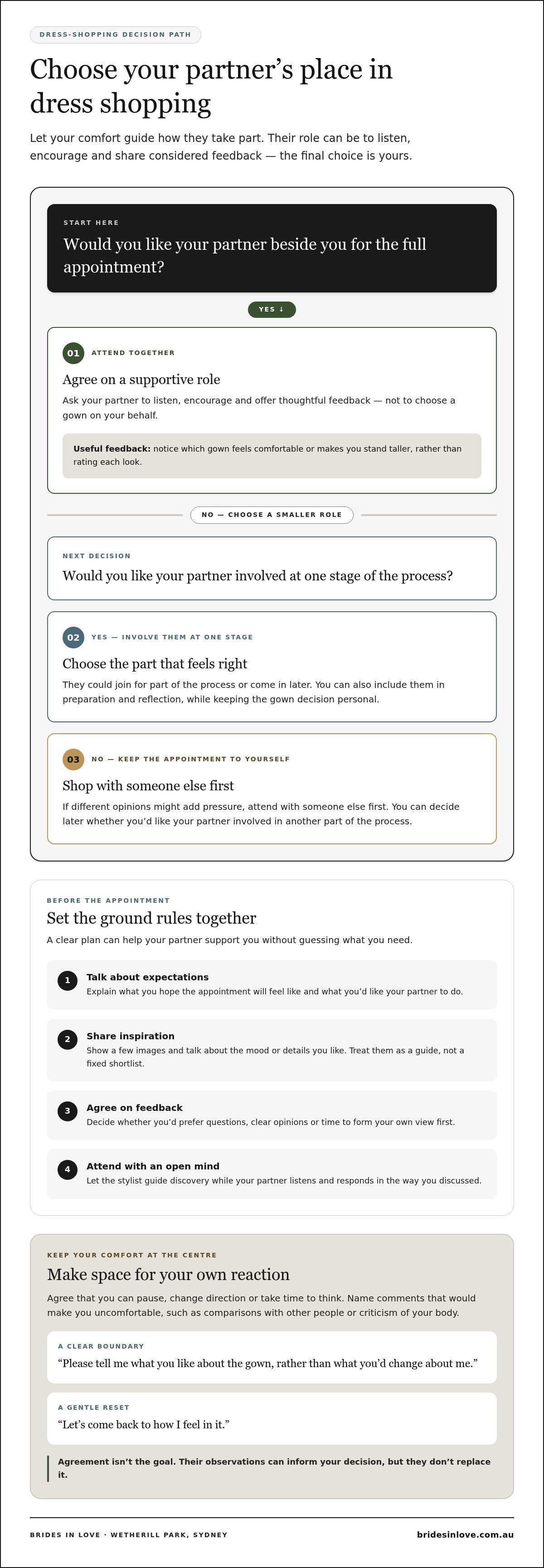
Choose the right level of partner involvement for your dress-shopping style
There’s more than one way to share the dress-shopping experience. Your partner could attend the appointment, help you prepare and talk it through afterwards, or join you once you’ve narrowed down your choices. Think about what would help you feel relaxed and able to focus, as well as practical details such as who you’d like beside you and how you want to experience the decision.
The best fit depends on your comfort, relationship preferences and practical needs, not a rule about how couples should shop. If seeing your partner’s reactions in person would reassure you, invite them along. If you’d rather concentrate on trying gowns without managing another person’s response, a smaller role can still make them feel included.
Attending together brings shared reactions in the moment; joining later preserves a private first look; helping before and after offers support without being in the fitting room. Each option has value. None makes your partner responsible for ranking gowns or speaking for you.
- Attend the appointment: Your partner can share the discovery with you and offer a reaction when you want one. The trade-off is that you’ll both be processing the moment together.
- Join at a later stage: You can explore gowns privately, then involve your partner in a later decision or reveal. This gives you space to form an initial view while still creating a shared moment.
- Help before and after: Your partner can support the planning, talk through your preferences and listen as you reflect afterwards. You keep the appointment as your own experience, though they won’t see your first reactions in person.
When attending the appointment together may suit you
Going together may feel right if you genuinely want your partner’s presence while you try on gowns. They can notice your reactions, share the excitement and offer the perspective you’ve asked for. Encourage them to listen to the stylist’s guidance and follow your lead: speak first about how each gown feels, then invite them to add their thoughts. Their attendance should feel welcome to you, not like an obligation to prove your commitment or include them.
When a smaller role may feel more comfortable
If you’d prefer more space, your partner can help with planning and talk with you afterwards, while you attend with another trusted support person. Or you might shop privately first and share a decision later, if that feels comfortable. These choices aren’t signs of distance; they’re deliberate ways to shape the experience around what helps you feel at ease.
To decide, picture the appointment itself. Would your partner’s presence help you feel grounded, or would you find yourself monitoring their reactions? Would hearing their thoughts later give you useful perspective without interrupting your own? Your answers can guide how to involve your partner in dress shopping while keeping the experience personal.
Whichever level you choose, your partner can contribute without turning gown selection into a contest. They might help you keep track of details, listen as you talk through your impressions or simply celebrate the moment. A helpful role leaves you room to notice what feels right to you.
Make a bridal appointment in Sydney feel relaxed and useful for both of you
A relaxed appointment begins with a shared understanding of what you want from the visit. Before heading to Brides in Love’s Wetherill Park showroom in Sydney, agree on how your partner can support you and what you’d like to focus on. Leave room for your preferences to develop as you explore, rather than treating the visit as a test of whether you both favour the same gown.
Your partner can help by listening to your reactions and giving you space to speak first after each try-on. If you’ve agreed on feedback, they can follow that approach and help you recall the details that mattered to you. A stylist can guide the conversation and keep the focus on your preferences, so your partner can participate without needing to lead or settle a difference of opinion.
What partners can do during a gown appointment
Between try-ons, let the bride set the pace. She might want a quiet moment to consider a gown before hearing anyone else’s view. When she’s ready, a partner can share the kind of observation she asked for, such as which details she seemed drawn to or how comfortable she looked moving in the gown. This makes their input practical and keeps her own response central.
Use the stylist as a guide, not a referee
A stylist can help you explore options and put your preferences into words, rather than decide whose opinion is right. If you and your partner respond differently to a gown, the stylist can bring the discussion back to what you value and how you feel wearing it. The consultation is a chance to discover, not a requirement to agree on every detail.
If you’re coordinating the appointment with other wedding plans, keep the visit centred on exploring gowns and learning what suits your vision. You can book a bridal appointment at Brides in Love in a way that fits your plans.
Turn partner support into a confident next step at Brides in Love
A useful appointment begins with a brief that reflects what you want from the experience. Tell your partner what you’re hoping to explore, agree on the kind of input you welcome and keep the final decision in your hands. That gives you a shared plan while leaving room for your preferences to take shape as you try on gowns.
At Brides in Love, a personalised one-on-one consultation gives you space to discuss what matters to you with a stylist. Your partner can join in the way that feels comfortable, whether they’re there to listen, offer considered feedback or share the occasion. The stylist can help you explore options without making agreement between you the measure of a successful visit.
What a personalised bridal consultation can add
Expert styling can help you put your preferences into words and consider gown details you may not have thought about yet. You can explore possibilities without needing to settle on a dress straight away. The Wetherill Park showroom is designed for discovery, so the appointment can be about learning what feels right to you, rather than proving that you and your partner have identical opinions.
Your partner’s role can stay clear throughout: listen to your reactions, contribute in the way you’ve agreed and support you as you make your own decision. You don’t need to manage competing verdicts or treat their favourite as the answer.
Take the next step together
As you plan your visit, consider what would make the appointment feel comfortable and enjoyable. Share that preference with your partner beforehand, then choose a time that fits your wedding-planning schedule. They can be part of the experience without taking over its direction.
Explore gowns at Brides in Love in a way that suits you both, with your preferences leading the visit. Book a bridal appointment when you’re ready to take that next step.
Make space for a decision that feels like yours
After your appointment, give yourself a little breathing room before deciding what comes next. Jot down the details you keep thinking about, from how a gown moved to the feeling it gave you. A clear note can help you reflect once the excitement of the visit has settled.
That’s one thoughtful way to approach how to involve your partner in dress shopping: share the experience, then take the time you need to consider it. If you’re ready to explore gowns in Sydney, book a bridal appointment at Brides in Love. Enjoy the discovery, and trust yourself to recognise what feels right.
Frequently Asked Questions
Should I bring my partner to my first wedding dress appointment?
Bring your partner if having them there is likely to help you feel at ease. If you’re unsure, consider what you’d want from their presence during the first try-on: reassurance, shared excitement or a second perspective. A useful way to approach how to involve your partner in dress shopping is to decide whether you want them there from the start or would prefer to invite them later. Either choice is valid.
What if my partner and I have different opinions about a wedding dress?
Different opinions are manageable; your partner’s reaction doesn’t have to settle the choice. Ask what specifically stood out to them, then consider whether that detail matters to you too. For example, they may love the train while you’re focused on how the bodice feels. You can value their perspective and still decide another gown suits you better. If you feel caught between opinions, take a break before discussing it again.
Can my partner help me choose a wedding dress if I want to keep it a surprise?
Yes, you can involve your partner and still keep parts of the look private. Decide what you’re happy to share, such as general inspiration or how the shopping is going, and what you’d prefer to save for the wedding day. You could keep the final gown under wraps while discussing practical plans together. Surprise traditions aren’t compulsory; choose the balance that feels enjoyable for both of you.
How can I involve my partner if they feel unsure about dress shopping?
Give them a straightforward task that doesn’t require fashion knowledge. They could listen while you describe what you like, help remember which gowns you tried or notice when you seem more relaxed. You might also explain a few terms or show them examples of details you’re drawn to before the appointment. For Sydney couples, preparing a short list of questions together can help a less confident partner feel included without needing to lead.
What should my partner wear to a wedding dress appointment?
Neat, comfortable smart-casual clothing is a sensible choice for a bridal appointment. Your partner should be able to sit, stand and move around comfortably, and choose an outfit that keeps the focus on supporting you. There’s no need to dress formally unless that’s what you both prefer. Comfortable clothing helps you both settle in and focus on the appointment.
Is it okay to change my mind after shopping with my partner?
Yes, you can change your mind after an appointment. Seeing gowns in person may shift what you value or give you a clearer sense of what you want to keep exploring. Your partner’s enthusiasm for a particular dress doesn’t commit you to choosing it. Give yourself time to think about how you felt wearing it, rather than deciding based only on the conversation in the moment. Your choice should feel right to you.


