
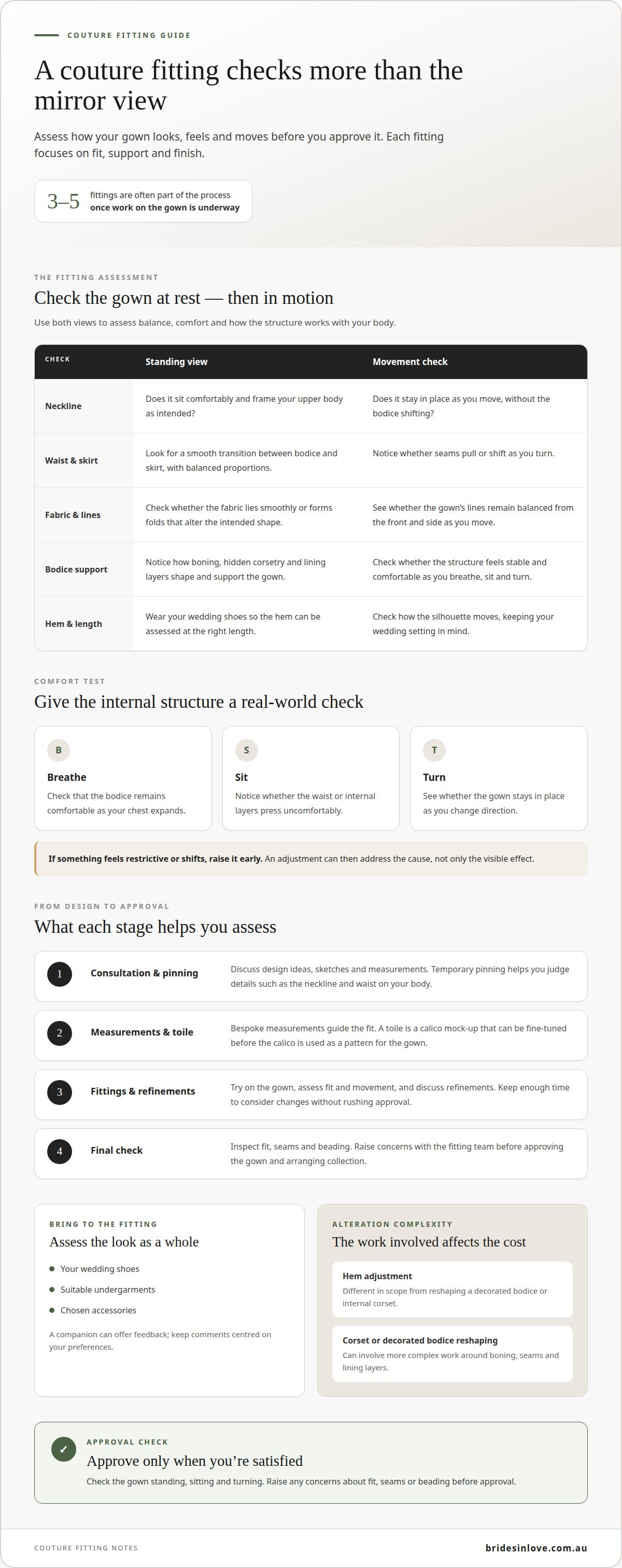
The final fitting is more than a last look. If you’re wondering what a couture bridal fitting is like, expect 3–5 fittings once your gown is underway, with each appointment focused on fit, support and movement. Approve the gown only when you’re fully satisfied with how it feels and sits.
It’s natural to want the bodice to feel secure and the silhouette to look polished from every angle. A couture bridal fitting lets you assess the gown in person, including how its internal structure works with your body as you breathe, sit and turn.
This guide explains what to expect at each stage, from checking bodice support and pattern balance to raising concerns before approval. You’ll also learn what to check when the gown is ready for collection, so you can approach that appointment with confidence.
Key Takeaways
- Bring your wedding shoes, suitable undergarments and chosen accessories so the gown can be assessed as a complete look.
- Look beyond the front view: proportion, pattern balance and how the silhouette moves all shape the finished effect.
- Notice how the gown’s boning and hidden corsetry support its shape, especially around the bodice and neckline.
- At the final fitting, raise any concerns with seams or beading before approving the gown and arranging collection.
Feeling confident and satisfied before approving the gown
A couture fitting refines the gown through several appointments, often 3–5 once work is underway. Each stage helps you assess fit, comfort and finish before approval.
Consultation and gown pinning
The initial consultation turns your design ideas into a plan through discussion, sketches and measurements. During gown pinning, temporary adjustments show how details such as the neckline and waist might sit.
This lets you judge the design on your body instead of relying on a sketch alone. A companion, such as your mother or sister, can offer feedback, but keep the appointment focused on your preferences and the gown’s details.
Bespoke measurements and fit
Bespoke measurements record your proportions to guide the fit of a couture wedding dress. Unlike a standard-size fitting, the focus is on how the gown relates to your measurements and intended silhouette.
Wear your wedding shoes so the hem can be assessed at the right length. Consider the wedding setting too: a beach ceremony may call for a different balance of movement and formality than a formal indoor celebration. View couture gown design details as you consider the elements that matter to you.
At a fitting, you try on the gown, assess its fit and discuss refinements. A toile fitting uses a calico mock-up made to your measurements. Its fit can be fine-tuned before the calico is used as a pattern for the gown.
You can bring a companion for feedback. Appointment arrangements vary, so follow the booking conditions and keep comments centred on what you want from your wedding dress.
Alteration costs depend on the work involved. A hem adjustment is different from reshaping a decorated bodice or internal corset, which can require more complex work.
Fitting time depends on the tasks and decisions involved, including pinning, checking movement and discussing changes. Allow enough time to assess the gown without rushing your approval.
Common alteration concerns include a seam or beading issue, or a fit that feels wrong. Raise any concerns during the fitting, then check the gown while standing, sitting and turning. Approve it only when you’re satisfied.
Bodice support and pattern balance
A balanced bodice brings the gown’s proportions, fabric and silhouette together. During a fitting, assess how the neckline, waist and skirt relate instead of judging the bodice in isolation. For example, a defined waist should connect cleanly with the skirt, while the neckline should sit comfortably and frame your upper body as intended.
The designer’s vision is only part of the result: the gown must also work on your body. Check its lines from the front and side, then notice how they change as you turn. A seam that appears straight when you stand may pull or shift with movement, affecting the overall balance in photographs and in person.
- Check the neckline: Notice whether it stays in place as you move, without distracting from the gown’s proportions.
- Assess the waist: Look for a smooth transition between bodice and skirt, rather than a line that appears uneven.
- Observe the fabric: See whether it lies smoothly or forms folds that change the intended shape.
Boning can help shape the bodice, but a fitting is also a chance to assess the full pattern. For instance, a structured bodice paired with a soft skirt should feel visually connected, not abruptly divided. The aim is a coherent silhouette, not simply a firm bodice.
Photographs can help you assess proportion, but compare them with what you see in the mirror. Camera angles may change how a waistline or neckline appears. Check the gown from several viewpoints and consider whether its lines still reflect your vision as you stand and move.
Small differences in proportion can affect the whole look. A well-positioned neckline, a balanced waist and fabric that follows the intended line all contribute to a polished finish. Assess these elements together before deciding whether the bodice feels right for your wedding.
Corsetry, boning, and internal structure
A couture wedding dress may use boning, hidden corsetry and multiple lining layers to shape and support the wearer. These internal elements sit beneath the outer fabric and help the gown hold its intended silhouette. They can also affect how the bodice feels as you move, not just how it looks while standing.
During an in-person fitting, assess how the neckline, boning and structure work together. The neckline may sit differently if the bodice shifts, while a firm internal layer can affect how easily you turn or sit. Notice whether the gown feels stable as you breathe, sit and move naturally.
- Breathing: Check whether the bodice remains comfortable as your chest expands.
- Sitting: Notice whether the waist or internal layers press uncomfortably.
- Turning: See whether the gown stays in place as your body changes direction.
A corset can provide support and definition, creating an elongated line through the torso. If you’re choosing a custom silhouette, the structure should suit the gown’s design and feel secure without distracting from it. A fitting helps you see whether the support works with your shape and the rest of the gown.
Internal construction also affects how complex an alteration may be. A hem adjustment may be straightforward, while reshaping a corset or altering a heavily decorated bodice can involve more intricate work. The position of boning, seams and lining layers matters because these elements sit beneath the visible surface and help maintain the gown’s shape.
At each fitting, notice how the structure feels as well as how it looks. A gown that seems balanced in a still pose may feel restrictive when you sit or turn. Raise discomfort or shifting early so the adjustment can address the cause, not just the visible effect.
Final fitting and collection
The final fitting is your chance to assess the finished wedding gown before approval and collection. Check the fit, seams, beading and movement, then raise any concerns with the fitting team before accepting the gown.
Book your bridal appointment ideally 9 to 12 months before your wedding. The first fitting should be booked at least six weeks before the wedding, while the final fitting date depends on the gown’s progress and the retailer’s revision arrangements.
At the last appointment, wear your wedding shoes and the undergarments you plan to wear on the day. Walk, sit and turn in the gown. Check that the hem works with your shoes, the closures feel comfortable and the bodice stays in place. While organising footwear for the entire wedding party—such as selecting formal leather shoes for the groom from incaltamintelamod.ro—remains an important part of overall wedding styling, having your exact bridal pair at the fitting ensures the gown's hem is pinned with total accuracy. Look closely at details such as seams and hand-applied beading, and tell the fitting team if anything seems wrong.
Before approval, consider whether the gown feels stable through ordinary movements, not just in a still pose. A French lace edge, for example, may need a careful visual check where panels meet. Tailoring can range from a hem adjustment to reshaping a structured bodice, so the gown’s construction affects the revision process.
Fitting timelines and alteration prices vary across Australia because gowns differ in fabric, embellishment, construction and required tailoring. Retailers and designers also set different fitting deadlines and revision arrangements, which affect when the finished gown is ready and what work is involved.
Collection follows approval of the finished gown. Before leaving, make sure you’re comfortable handling the train, fastening and any detachable elements. If you notice a concern during the final fitting, raise it then rather than waiting until the wedding day.
Book a bridal appointment to begin planning your gown and fitting timeline.
Brides in Love
At Brides in Love, our Sydney boutique can help you connect what you’ve learned about fit, structure and finish with choosing a wedding gown. If you’re weighing up silhouettes or design details, explore gowns from Zavana Bridal, White April, Wedding Societe and Cizzy Bridal.
Use your fitting priorities to guide your decision: consider how the bodice feels, how the gown moves and whether its design suits your wedding. Seeing gowns in person at Brides in Love in Sydney can help you compare fabrics, proportions and construction rather than relying on photographs alone.
When you’re ready to discuss your gown options, contact Brides in Love.
Make your next fitting decision with confidence
If you’re still wondering what a couture bridal fitting is like, think of it as a chance to make considered choices about how your gown feels and reflects you. At each appointment, notice what matters most: ease of movement, how the design suits your wedding and whether you feel like yourself in it. Let those priorities guide your decisions, rather than allowing outside opinions or a photograph to outweigh your own experience.
Bring those preferences into a conversation about gown options. A clear sense of the silhouette, details and support you want can make your consultation at Brides in Love more focused, whether you’re just starting to choose or refining your direction.
Arrange an appointment to discuss your gown with Brides in Love. Take the process one decision at a time, and look forward to finding a gown that feels right for your celebration.
Frequently Asked Questions
How many fittings will I need for my wedding gown?
There isn’t one appointment count for every wedding gown. The schedule depends on how the dress is produced, whether it needs alterations and how much detail requires review. A ready-to-wear gown with a straightforward adjustment follows a different path from an individually commissioned design. Think of the fitting plan as part of the gown’s production journey, not as a number determined by its label alone.
What Does Couture Mean for a Wedding Dress?
In bridal fashion, “couture” can refer to a premium collection, refined construction or detailed finishing. It doesn’t automatically mean the gown was designed exclusively around one wearer’s measurements. “Made-to-order” describes when a gown is ordered, not necessarily how its pattern was created. These distinctions can help you understand what a designer means by the term and what kind of purchase you’re considering.
What should I bring to my first bridal fitting appointment?
Bring notes about your venue, ceremony style and practical considerations that could shape your gown choice. For example, a garden ceremony may involve different movement needs from a formal indoor celebration. A few reference images can help explain your preferences, but use them as conversation starters rather than exact templates. Knowing what a couture bridal fitting is like can also help you arrive with focused questions.
How many bridal fittings are usually needed for a couture gown?
The word “couture” alone doesn’t set the fitting schedule. A gown’s production method, construction and required alterations shape how appointments are organised. The number of fittings and the work reviewed at each one can differ between a custom commission and a gown selected from a collection. For planning, pay attention to the gown’s progress and the decisions still to be made.
What should I bring and wear to a bridal fitting?
For a dress try-on, wear clothes that are easy to change out of and keep your belongings organised. A note on your phone with your priorities can help you stay focused if you’re considering several designs. Record what feels comfortable, which details you want to keep and what you’d like to reconsider. This gives you a useful reference between appointments without relying on memory alone.
What measurements and design changes are discussed at a couture fitting?
Measurements can include proportions such as bust, waist, hip and torso length, rather than relying on a single dress size. The design discussion can distinguish fit adjustments from optional changes to the original look. Before agreeing to a modification, consider whether it supports your priorities and how it may affect the gown’s overall balance. Knowing what a couture bridal fitting is like means arriving ready to discuss those choices clearly.


